
Introduction of a New Metric
Social media has created a system in which we can now visually graph our relationships showing how we are connected to people. Additionally, by observing how we interact with one another on social media, we can also see who in our social graph influences us based on how we respond to their social interactions, how frequently we interact with them, and how they influence our behavior. It isn’t a perfect system, but social media allows us to quantify certain behaviors that arguably hold a correlational relationship with influence. For instance, if you consistently respond to a person’s tweets by retweeting their content, “favoriting,” their tweets, or mentioning them in your own tweets, it is arguably because that person influences you. This is the premise used to determine social capital in the social media world.
What was once impossible (or perhaps just extremely challenging) to quantify, is being attempted by social capital companies such as Klout.com. Klout syncs with your social accounts and measures network, amplification, and true reach. Based on the data it analyzes, it generates a Klout score on a scale of 0 to 100. This new metric is somewhat controversial in the social space but rather than getting into that debate, it represents an attempt to quantify something we previously were unable to quantify. Online personal branding has become so important, it has spawned new companies in reputation management, people search engines, social capital measurement companies, social media background check companies, and a variety of other related businesses. Companies have partnered with Klout to identify influencers in niche areas to offer “perks” such as free products or services. If online presence, influence, and reputation is important enough to spawn new industries and to offer free “perks” to influencers, will we one day see it as a common metric on resumes to influence employers?
It may seem like a silly question but regardless of whether or not it is a Klout score we may see, this type of metric is indicitive of what the future may hold. Perhaps one day there will be some agreed upon standard measurement that is believed to be an accurate, trustworthy measurement of a person’s reputation or the “value” they bring to an organization as represented by some sort of point assignment.
What are your thoughts?
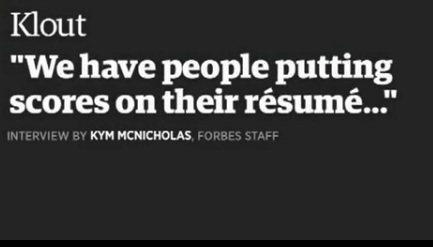
Klout CEO/co-founder, Joe Fernandez says in this May, 2011 interview that some people put Klout scores on their resume for employment!






Klout has a long way to go before it should be included on a resume.
1. Klout scores don’t measure the ability of someone to develop a social media strategy.
2. Klout scores don’t measure the difference between positive and negative influence as far as I am aware. If people have negative things to say about a brand in social media it still positively impacts the score.
3. Does Klout influence impact purchase decisions? People who publish good quotes on Twitter get RTs. This positively affects there score. But does that make you want to buy something?
4. If a company isn’t going to let an employee use their own social media account for work what does it matter when their Klout score is? If they are, then the people they “influence” must match those the company is trying to reach.
As you mentioned, Klout is a good in aiding marketing departments identify those who would be good brand ambassadors or benchmarking as part of the social media performance metrics for company projects. However, in my opinion would be nothing but a short cut for an HR department to screen resumes and potentially rule out better qualified candidates.
David,
Great points. This is exactly why I think it is a compelling discussion. However, if it isn’t Klout, will some metric be a future trend? There is no way of knowing but it is interesting since companies are in the beginning stages of attempting to measure something unclear with quantifiable metrics – it is an interesting challenge and an interesting trend to monitor to see what will happen in the future.
Great points. This is exactly why I think it is a compelling discussion. However, if it isn’t Klout, will some metric be a future trend? There is no way of knowing but it is interesting since companies are in the beginning stages of attempting to measure something unclear with quantifiable metrics – it is an interesting challenge and an interesting trend to monitor to see what will happen in the future.
+1